

Key Takeaways
- A sled push is an exercise that uses coordinated efforts from your legs and upper body to push a weighted sled forward, building up muscles through force and resistance.
- Training with sled pushes primarily works out the quads, glutes, and calves, while secondarily targeting the hamstrings, hip flexors, abs, obliques, the lower back, and upper body muscle groups.
- Lowering the sled handle height can activate the glutes and the posterior chain.
- Integrate sled pushes into your workouts 2–4 times per week, and ensure full knee extensions to keep sled pushes more knee-friendly.
What is A Sled Push?
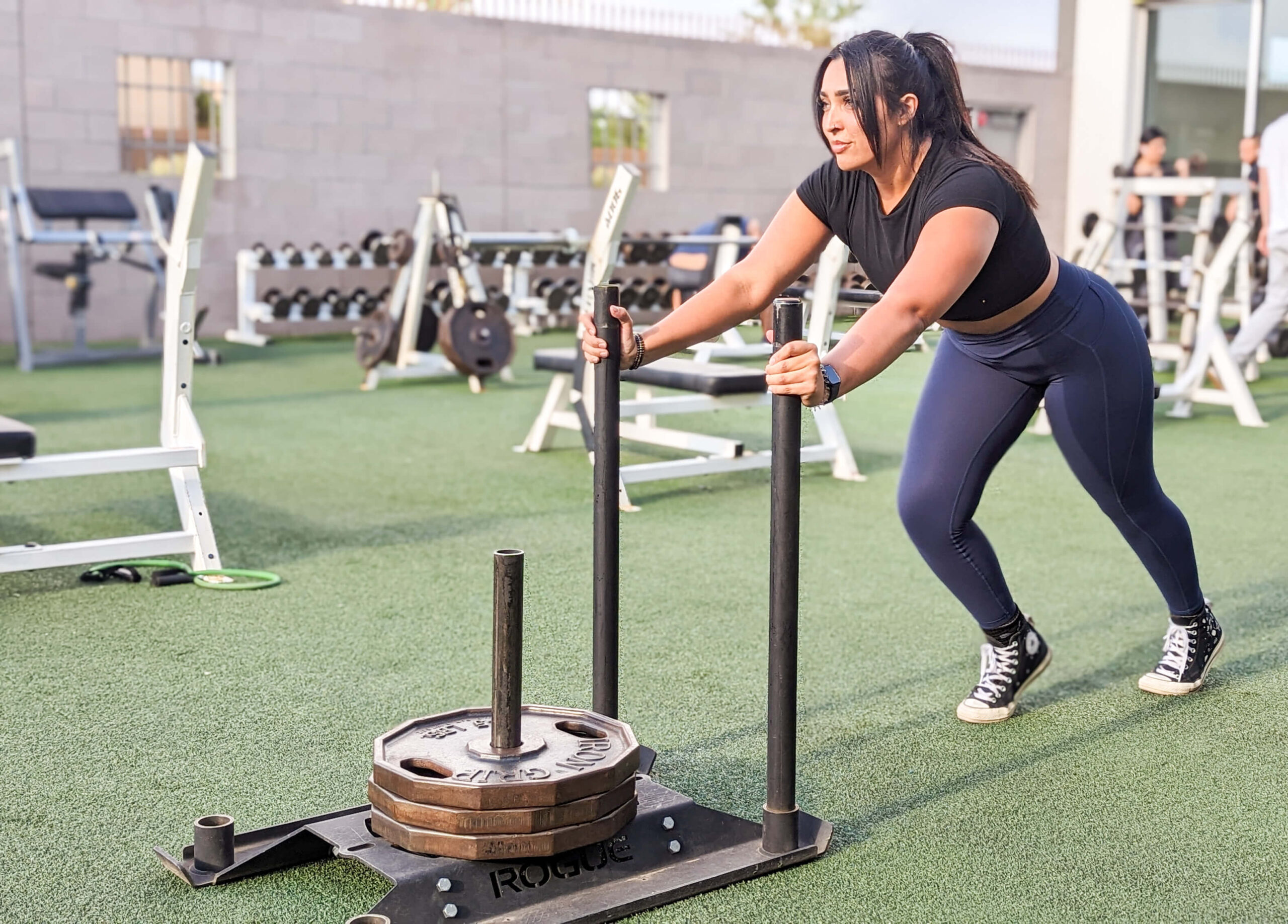
A sled push is a strength and conditioning exercise. It requires coordinated effort from your upper and lower body to push a weighted sled across a surface, usually turf or a gym floor, using your arms and legs to generate forward force.
Widely used in performance training, sled push workouts combine load, distance, and sustained effort, making them highly effective for building lower body muscle strength.
What Muscles Does Pushing a Sled Work?
Sled pushes build muscle by being a full-body movement, and are a great addition when considering the benefits of strength training for women and men. The majority of the work comes from the lower body, while the upper body and core help stabilize and transfer force.
Primary Muscles Worked
-
Quadriceps
Quads are constantly moving in sled pushes, staying engaged throughout the entire push — especially when using heavier weight or a slower pace.
-
Glutes
Glutes contribute to power output during sled pushes. You can target them more directly by increasing the resistance or leaning your body further into the sled.
-
Calves
Calves assist with pushing off the ground at the end of each step. They become more active during faster sled pushes where quick, repeated strides are needed.
Secondary Muscles Worked
-
Hamstrings
Hamstrings assist with hip extension and help control each stride throughout the movement.
-
Hip Flexors
Hip flexors at the front of the hips lift and drive your legs forward between steps, maintaining a smooth, efficient rhythm.
-
Chest, Shoulders, and Triceps
These upper body muscles press into the sled handles and maintain arm position, especially when using higher handles or a more upright posture.
Stabilizing Muscles Worked
-
Abs and Obliques
Abs and obliques stabilize your core and help transfer force from your legs into the sled, keeping your body aligned.
-
Lower Back
Lower back muscles including the erector spinae, multifidus, and quadratus lumborum (QL) maintain spinal stability and posture, particularly when pushing heavier loads or leaning forward.
Why Quads and Glutes Drive Sled Push Training
Of the muscles worked by sled pushes, quads and glutes are dominant because of how force is produced and applied during movements.
Quads Are the Primary Driver
The quadriceps take on a leading role because every step requires strong and repeated knee extension. The slightly forward-leaning position that drives you into the ground places constant demand on the front of the thighs.
Quads also stay active versus having a reset between reps, resulting in:
Continuous Tension
Sled pushes keep muscles under continuous tension throughout the movement, creating the sustained load that supports muscle building.
Accumulated Fatigue
Repeated contractions build accumulated fatigue across the working muscles, progressively increasing endurance over time.
High Force Demands
During heavy pushes, the muscles face higher force demands to keep the sled moving, driving greater strength and power adaptation.
Glutes and Their Role in Forward Force
The gluteus muscle group is essential for creating forward motion through hip extension. As you lean into the sled, your hips move into a position that requires the glutes to produce more force to keep you moving forward.
Their involvement becomes more noticeable when:
Lean Your Torso Forward
Leaning your torso forward shifts more of the workload onto the posterior chain, increasing glute activation throughout the push.
Take Longer, More Powerful Steps
Each longer stride demands greater hip extension, which the glutes are primarily responsible for, making every step a stronger glute stimulus.
Increase the Load on the Sled
Heavier resistance requires stronger contractions from the glutes to maintain movement, directly increasing the demand placed on the muscle.
When performed with proper technique and sufficient resistance, sled pushes grow glutes very effectively.
How Are Sled Pushes Different From Other Leg Day Exercises?
How force is produced and sustained notably differentiates sled pushing from more traditional leg day workouts:
Horizontal Force Instead of Vertical Loading
Unlike squats or lunges that move weight up and down, sled pushes train muscles to apply force forward, targeting the body in a different plane of movement.
Continuous Muscular Tension
With no reset between reps, each step keeps the working muscles engaged, increasing time under tension compared to traditional lower body exercises.
Reduced Soreness With Higher Output
With no lowering phase like squats or lunges, sled pushes cause less structural muscle damage, allowing people to train harder more often.
How Sled Push Handle Heights Change the Muscles Worked
Altering handle height affects your torso’s posture and determines how force is distributed.
When handles are moved to a lower position on the sled, you lean forward more for each push. This increases posterior chain activation (the glutes, hamstrings, lower back, and lats) due to greater hip extension demands. With a noticeable reduction in upper body reliance, you can make sled pushes even more of a lower-body dominant workout to grow glutes and quads.
For the opposite effect, or for reduced load on the hips, move the sled handles to a higher position. This is often a great beginner-friendly way to do sled pushes. With your torso in a more upright position, muscle involvement in the chest, shoulders, and triceps eases the pressure on your lower body, making you feel more stable.
Are Sled Pushes Knee-Friendly?
Yes. Sled pushes are a great knee joint-friendly exercise, especially compared to high-impact or heavily loaded movements that don’t distribute pressure.
Less Knee Joint Stress
Because sled pushes don't require muscles to perform lifting and lowering phases, which add pressure on joints and connective tissue, training is easier on the knees.
Controlled Movement Pattern
You dictate the pace of a push, making it simpler to stay within a comfortable range of motion throughout the entire set.
Even Force Distribution
The movement spreads pressure across multiple joints and muscle groups rather than isolating stress on one area, reducing the risk of overloading any single structure.
How Often Should You Do Sled Pushes?
Working muscles out with a sled push routine can happen frequently thanks to their low recovery demand. The flexibility they offer make them valuable for people who want to build muscle without vertical force.
- 2–3 sessions per week supports strength and muscle development without excessive fatigue.
- 3–4 sessions per week works well for conditioning and overall fitness improvements.
- Flexible integration into leg day workouts adds strength training without significantly impacting recovery.
Push Your Training Further at Defined Fitness in New Mexico
At Defined Fitness’ club locations, we help you train with purpose so every workout moves you closer to your goals. Learn about our membership options so you can step onto the turf and take lower body workouts to the next level.