
Key Takeaways
- To do a Smith machine squat, set the bar just below your shoulders, lock in the safety stops, step your feet 4 to 8 inches forward, and squat until your thighs are parallel with the floor.
- Facing away from the machine works your glutes and hamstrings, while facing it shifts emphasis to your quads, depending on your gym's setup.
- Set the safety stops before loading the bar so every rep has a backup, especially without a spotter.
- The exercise mainly works your quads, glutes, and hamstrings, and foot placement decides how much load each one takes on.
- A Smith machine trades some stabilizer work for a controlled path that lets you push closer to failure than a barbell squat.
You’ve probably watched someone squat a loaded barbell with no spotter nearby and wondered how they trust the setup enough to push heavy. A Smith machine answers that question, since the bar rides on fixed rails and can’t tip, drift, or crush you if a rep goes wrong.
This built-in support makes it one of the most approachable ways to squat heavy weights, whether you’re new to lifting or hesitant to load a free bar without a spotter. While the machine has more support than a barbell, you should still know how to do a Smith machine squat with proper form to avoid injury and get the most value from it.
How to Do a Smith Machine Squat: 5 Steps
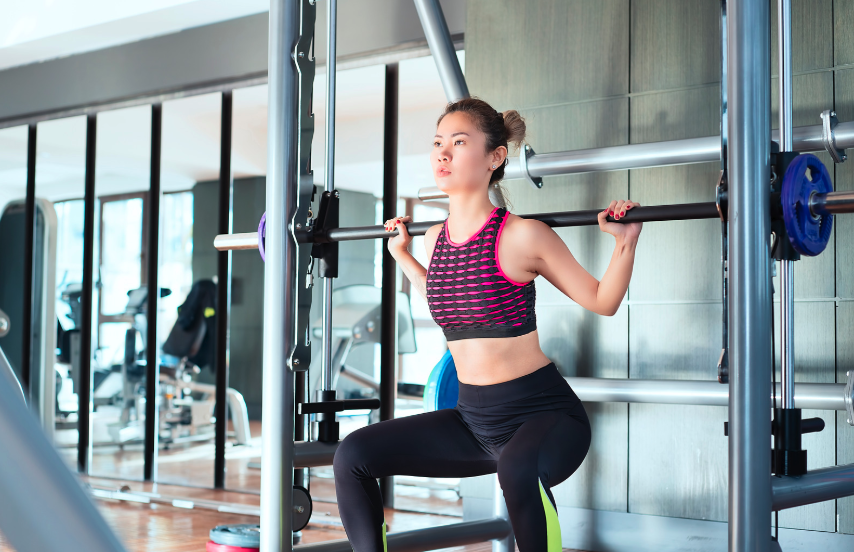
To do a Smith machine squat, set the bar height just below your shoulders, lock the safety stops, step your feet three to six inches forward, and squat until your thighs are parallel with the floor. Add weight gradually as each part of the setup starts to feel comfortable.
If you’d like more guidance on how to perform a Smith machine squat, review the following five steps:
Step 1: Adjust the Bar Height
Set the bar just below your shoulders while standing upright underneath it. Racking it too high forces you onto your toes, while setting it too low rounds your shoulders forward before the set starts. Test the height with an empty bar before loading plates.
Step 2: Set the Safety Stops
Slide the safety catches to just below your lowest squat depth before adding weight. These stops catch the bar if you can’t finish a rep, so you can push hard without a spotter. Test them with a light rep first, since a catch set too high cuts your depth short and one set too low won’t catch you at all.
Step 3: Position Your Feet 3 to 6 Inches Forward
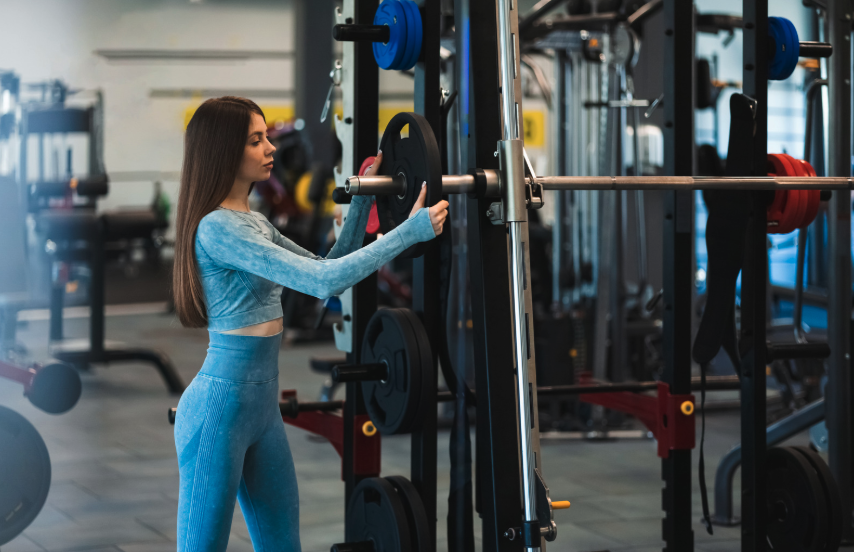
Smith machine squat foot placement is the detail that trips up most lifters. Step your feet three to six inches in front of the bar instead of directly beneath it. The bar’s fixed path can’t shift backward the way a free bar does when you push your hips back to start the descent.
NASM’s breakdown of squat biomechanics explains that your hips, knees, and ankles all need to bend together as you descend. Since the bar itself can’t move to accommodate that motion, shifting your feet forward gives your joints room to bend the way they’re supposed to.
Moving your feet forward restores a workable shin angle so your knees track over your toes. If your shins angle sharply forward instead of staying close to vertical at the bottom of the rep, walk your feet out another inch or two and retest.
Step 4: Grip the Bar and Unrack
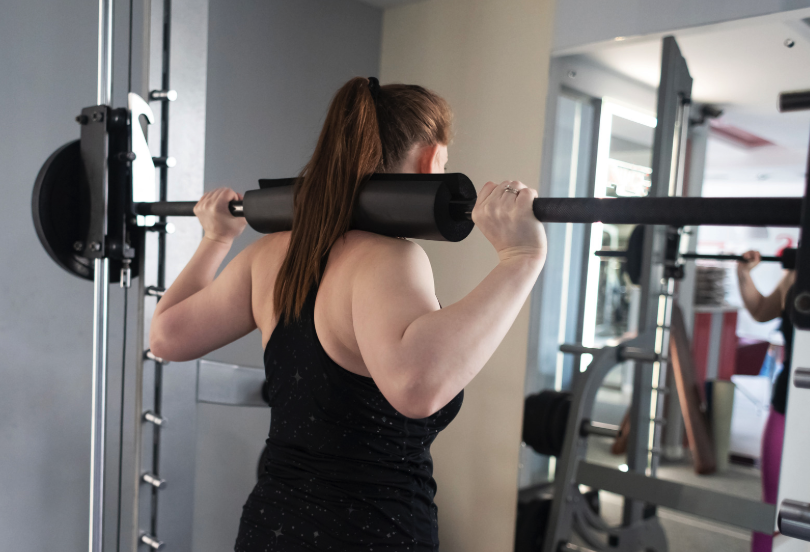
Reach up and grip the bar just outside shoulder-width, and duck under so it rests across your upper traps rather than your neck. Squeeze your shoulder blades together to create a shelf and brace your core. Straighten your legs to lift the bar off the hooks, and rotate your wrists to unlock it.
Step 5: Squat Down and Stand Back Up
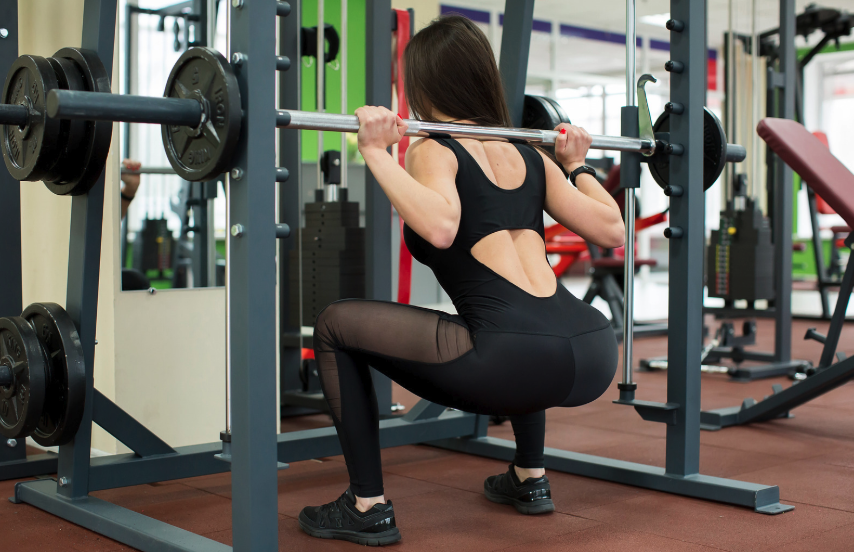
With your feet set and the bar unlocked, work through the rep in this order:
Which Way Should You Face on a Smith Machine Squat?
Facing away from the machine works your glutes and hamstrings, matching a standard squat, while facing the machine shifts emphasis to your quads.
This distinction is specific to angled Smith machines, which most commercial gyms use today. Facing away lets the bar travel slightly backward as you descend, matching the natural hip hinge of a barbell squat.
The machine-facing setup reverses that, sending the bar forward and often feeling more stable for beginners. Direction matters far less on a straight, vertical-track machine, so check which type your gym has and test both with an empty bar.
Common Smith Machine Squat Mistakes
Good Smith machine squat form comes down to a handful of repeatable details, and most mistakes trace back to skipping one of them. Learn more about the top five mistakes people make when doing Smith machine squats:
- Feet placed under the bar: Standing under the bar forces your knees forward and lifts your heels at depth, so set your foot position before you unrack it.
- Skipping the core brace: The fixed path handles your balance, so it's easy to skip bracing, even though your core still needs to work the same way it would on a free-weight squat.
- Loading weight before setting the safety stops: Setting stops after you've already loaded plates leaves no backup if a rep fails, so set them first with an empty bar.
- Jumping to a heavy weight too fast: The machine's stability can make a load feel more manageable than it actually is, so add weight gradually and keep your foot placement consistent.
What Muscles Does the Smith Machine Squat Work?
The Smith machine squat primarily works your quads, glutes, and hamstrings, with foot placement shifting how much load each muscle takes on.
This compound lift works several muscle groups at once. Quadriceps handle most of the knee extension, especially with feet closer to the bar. Glutes take on more of the hip extension the further forward your feet sit, while hamstrings and your core help stabilize the bar throughout.
If you’re building a full-week split, pair squat-focused leg day with a dedicated pull day workout to balance pushing and pulling volume.
Smith Machine Squat vs. Barbell Squat vs. Hack Squat
Wondering how Smith machine squats compare to other common types of squats? Find out how barbell, hack, and Smith machine squats differ in terms of their stability, muscle emphasis, and best use case.
| Exercise | Stability | Muscle Emphasis | Best For |
|---|---|---|---|
| Smith Machine Squat | High (fixed bar path, safety stops) | Quads, glutes, hamstrings (emphasis shifts with foot placement) | Training near failure without a spotter |
| Barbell Back Squat | Low (bar balance is on you) | Full lower body plus core and stabilizers | Building total-body strength and coordination |
| Hack Squat | High (angled sled, back pad) | Quad-dominant | Isolating quad growth with less core demand |
The barbell squat demands more stabilizer work, building coordination the Smith machine can’t fully replicate. If your gym has a hack squat machine, it’s worth adding into your routine as another way to target the same muscles. Since squats are quad- and knee-dominant, pair leg day with a hip-dominant movement like the trap bar deadlift to round out the rest of your lower-body training.
Are Smith Machine Squats Good for You?
Yes, for most lifters. Smith machine squats are a safe, effective way to build lower-body strength, especially when you’re training alone or pushing close to failure.
The exercise earns a place in most programs, even though it won’t fully replace free-weight squats. It works well as a stepping stone, letting you build confidence with the guided pattern before testing the same squat with a barbell. Either way, aim for consistent depth, a braced core, and a rep you control the whole way through.
Add Smith Machine Squats to Your Workout Routine at Defined Fitness
Every Defined Fitness location gives you room to build a real strength routine around the Smith machine squat. All eight clubs include free weights, strength machines, and a dedicated turf training zone, so you can pair Smith machine squats with trap bar deadlifts, hack squat variations, or a full lower-body circuit without waiting on equipment. When you want more structure than solo lifting offers, a trainer can dial in your setup and build a program around it.
Learn more about our strength-training equipment and other amenities today. If you’re ready to try Smith machine squats at one of our gyms, please find your nearest location and come in for a free trial!