Key Takeaways
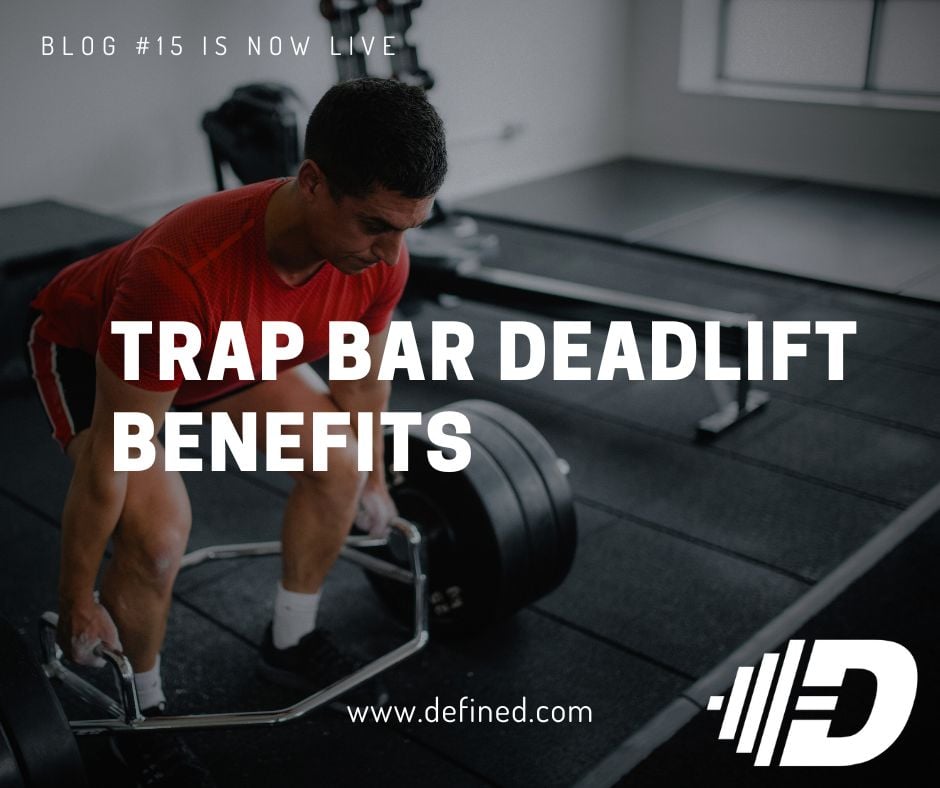
- A trap bar deadlift is a deadlift variation where you stand inside a hexagonal bar and lift using neutral-grip handles at your sides.
- Because the load sits in line with your body, the trap bar places less demand on your lower back and more on your knees than a straight-bar deadlift.
- Trap bar deadlifts work your quads, glutes, and hamstrings, with more quad involvement than conventional deadlifts.
- Research shows the trap bar can produce more force, power, and speed than a straight bar, which makes it useful for athletic training.
- Beginners can start on the high handles with an empty bar and progress to the low handles as their form and mobility improve.
If you’re looking for a way to deadlift that ‘s easier to learn and doesn’t put as much strain on your lower back, trap bar deadlifts might just be for you. As an alternative deadlift, trap bar deadlifts still target muscles throughout the entire body and offer similar benefits to the traditional exercise, but they’re often easier for beginners due to the trap bar’s design.
Whether you’re trying to switch up your workout routine or are starting a new one from scratch, our guide to trap bar deadlifts can help you decide if they’re right for you.
What Is a Trap Bar?
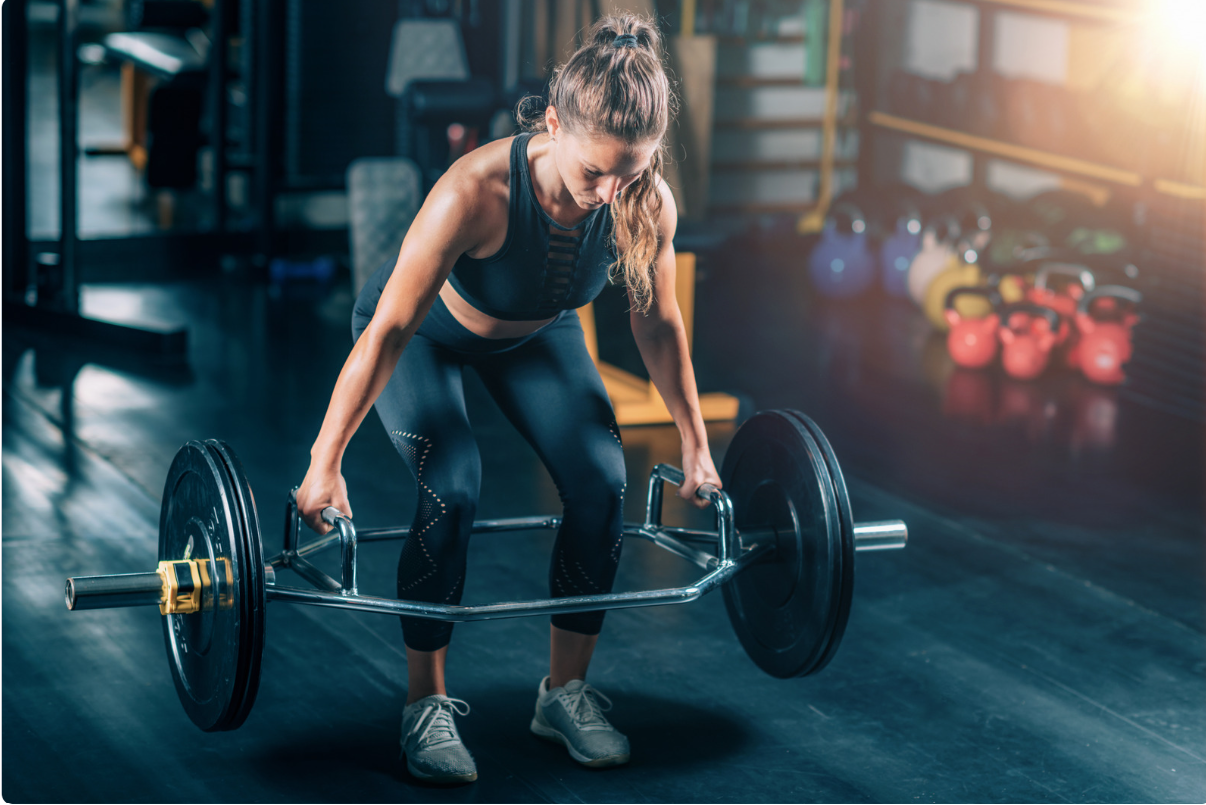
A trap bar, also called a hex bar, is a hexagonal barbell you stand inside, with handles at your sides instead of a straight bar in front of you.
The unique design enables the user to take hold of handles positioned at their sides with a neutral grip (palms facing each other), rather than in front of them as with a traditional barbell.
The trap bar’s hex shape and its handles’ position help center the load around the lifter’s body, reducing stress on the lower back and promoting a more natural lifting form. Alongside being used for deadlifts, hex bars are regularly used for shrugs, overhead presses, squats, lunges, and trap bar farmer’s carries.
What Is a Trap Bar Deadlift?
A trap bar deadlift is a deadlift variation where you stand inside a hexagonal bar and lift it from the floor using handles at your sides.
Because the load sits at your sides, you can bend your knees more and keep your torso more upright than you would with a straight bar. Many coaches describe the result as a hybrid of a squat and a deadlift.
It’s still a hip hinge at heart, so your hips should travel back as you lower the bar instead of dropping straight down. The setup makes the trap bar deadlift a popular choice for beginners, athletes, and anyone who wants to train heavy with less lower-back demand than a conventional deadlift.
Trap Bar Deadlift Muscles Worked
Trap bar deadlifts work your entire lower body, with your quads, glutes, and hamstrings doing most of the lifting. Your spinal erectors, lats, traps, core, and forearms stabilize the bar and keep your torso rigid as you stand up.
- Quadriceps: The upright torso and deeper knee bend put your quads to work as you drive the bar off the floor.
- Glutes and hamstrings: These muscles extend your hips and bring you to a full standing position at the top of each rep.
- Upper back and traps: Your lats and traps hold the bar steady at your sides and keep your shoulders from rounding forward.
- Core and grip: Bracing your abs protects your spine, while your forearms hold the handles through the whole set.
Research backs up the trap bar’s quad-heavy reputation. In a 2016 study published in the Journal of Strength and Conditioning Research, the hex bar produced greater quad activation, while the straight bar produced more hamstring activation during the lift and more lower-back activation while lowering the weight.
Is a Trap Bar Deadlift Better Than a Conventional Deadlift? Trap Bar Deadlift Vs. Conventional Deadlifts
Neither is better overall. A trap bar suits beginners, general strength, and athletic training, while conventional deadlifts matter most for powerlifters.
Trap bar deadlifts and conventional deadlifts differ in several key ways.
| Feature | Trap bar deadlift | Conventional deadlift |
|---|---|---|
| Load position | At your sides, in line with your body | In front of your shins |
| Grip | Neutral (palms facing in) | Overhand, mixed, or hook |
| Torso position | More upright | More forward lean |
| Muscle emphasis | More quads | More hamstrings and lower back |
| Lower-back demand | Lower | Higher |
| Learning curve | Easier for most beginners | More technique-dependent |
| Powerlifting specificity | Not a competition lift | Competition lift |
In terms of form, the trap bar allows for a more upright posture, with the bar surrounding the lifter’s body. This design makes trap bar deadlifts easier on the lower back and more beginner-friendly. The conventional deadlift, on the other hand, requires a deeper hip hinge and knee flexion, focusing more on the posterior chain (muscles on the back of your body).
Grip is another key difference, as trap bars use a neutral grip, which is more comfortable and reduces grip strain, while conventional deadlifts rely on an overhand, mixed, or hook grip. If your grip gives out before your legs do on either bar, lifting straps can help you finish the set.
Additionally, the trap bar’s weight distribution lets many lifters handle heavier loads while placing less demand on the lower back.
Lastly, trap bar deadlifts engage the quads more, whereas conventional deadlifts target the hamstrings and lower back more intensively.
If you compete in powerlifting, keep conventional or sumo deadlifts in your program, since those are the versions you’ll perform on the platform. For everyone else, the trap bar can serve as your main deadlift.
Why Are Hex Bar Deadlifts Good For You? The Top 5 Trap Bar Deadlift Benefits
Trap bar deadlifts, also called hex bar deadlifts, are an excellent alternative to traditional deadlifts, offering several benefits that make them ideal for many people’s strength training routines. If you’re on the fence about adding this exercise to your routine, check out the following five primary trap bar deadlift benefits:
1. Less Demand on Your Lower Back
The trap bar deadlift places less strain on the lumbar spine compared to traditional deadlifts. Its design encourages a more upright torso position, which helps reduce lower-back tension and makes it a comfortable starting point if you’re new to lifting.
A 2011 study of 19 male powerlifters found the hex bar produced lower peak demand at the lumbar spine, hips, and ankles than a straight bar. The same study measured higher demand at the knees, so the trap bar shifts part of the workload from your back to your legs.
2. An Easier Learning Curve for Beginners
The trap bar’s neutral grip and centered load path make it easier to maintain proper form, especially for those struggling with the straight-bar deadlift. The more natural body mechanics make it an excellent choice for newcomers to weightlifting.
Once you’re comfortable with the movement, it pairs well with simple dumbbell exercises for beginners to round out a full-body routine.
3. More Quad Emphasis for Lower-Body Strength
Compared to conventional deadlifts, the trap bar deadlift shifts more focus to your quadriceps due to its more upright position and deeper knee bend. The result is a lift that builds strength through your whole lower body, which carries over to everyday tasks like standing up from a low seat or lifting a heavy box off the floor.
4. The Ability to Lift Heavier Loads
Many lifters find they can handle heavier loads with the trap bar due to its advantageous positioning. In the 2011 study, powerlifters averaged a one-rep max of about 584 lbs (265 kg) on the hex bar compared to about 540 lbs (245 kg) on a straight bar. Results vary by lifter, though. The 2016 study found no significant difference in one-rep max between the two bars, so treat a bigger number as a possible bonus.
5. More Power and Speed for Athletic Training
If you play a sport or want more explosive strength, the trap bar has an edge. The 2016 study found hex bar deadlifts produced greater peak force, peak power, and peak velocity than straight-bar deadlifts. The 2011 study reported higher peak power with the hex bar as well, at about 4,872 watts compared to 4,388 watts.
Those results make the trap bar a strong choice for building strength you can use on the field or court.
How to Do a Trap Bar Deadlift With Proper Form
Getting all the benefits of trap bar deadlifts starts with knowing how to do them properly and safely. With the right trap bar deadlift form, you can reduce your risk of injury and strengthen your muscles more effectively. Review the following steps for properly performing a hex bar deadlift below:
1. Step Into the Center of the Bar
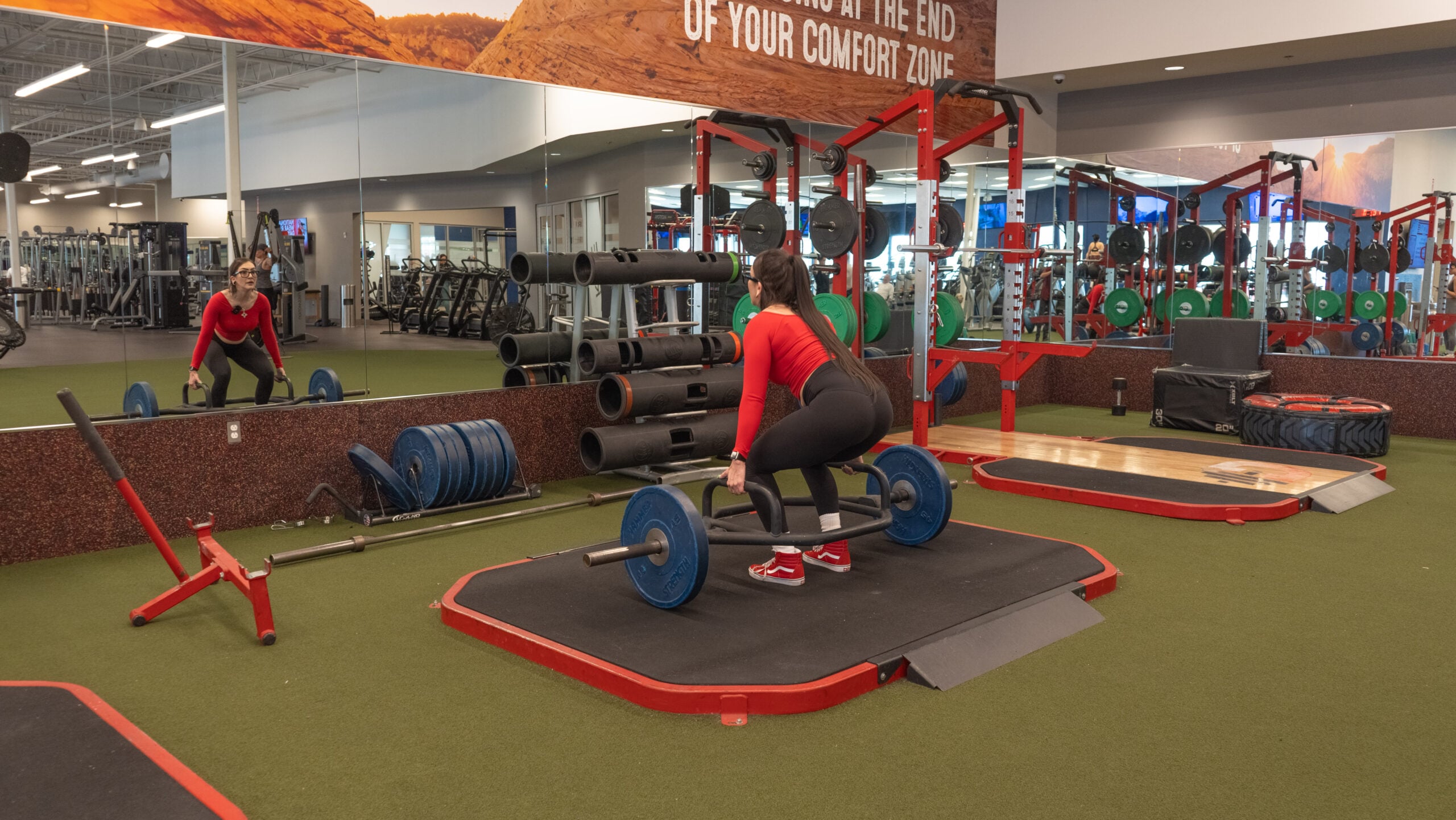
Stand inside the trap bar with your feet hip- to shoulder-width apart and your weight distributed evenly. Center yourself so the handles line up with the middle of your feet, which keeps the load balanced from front to back. Tuck your chin slightly, and keep it in this position throughout the entire exercise.
2. Hinge Down and Grip the Handles
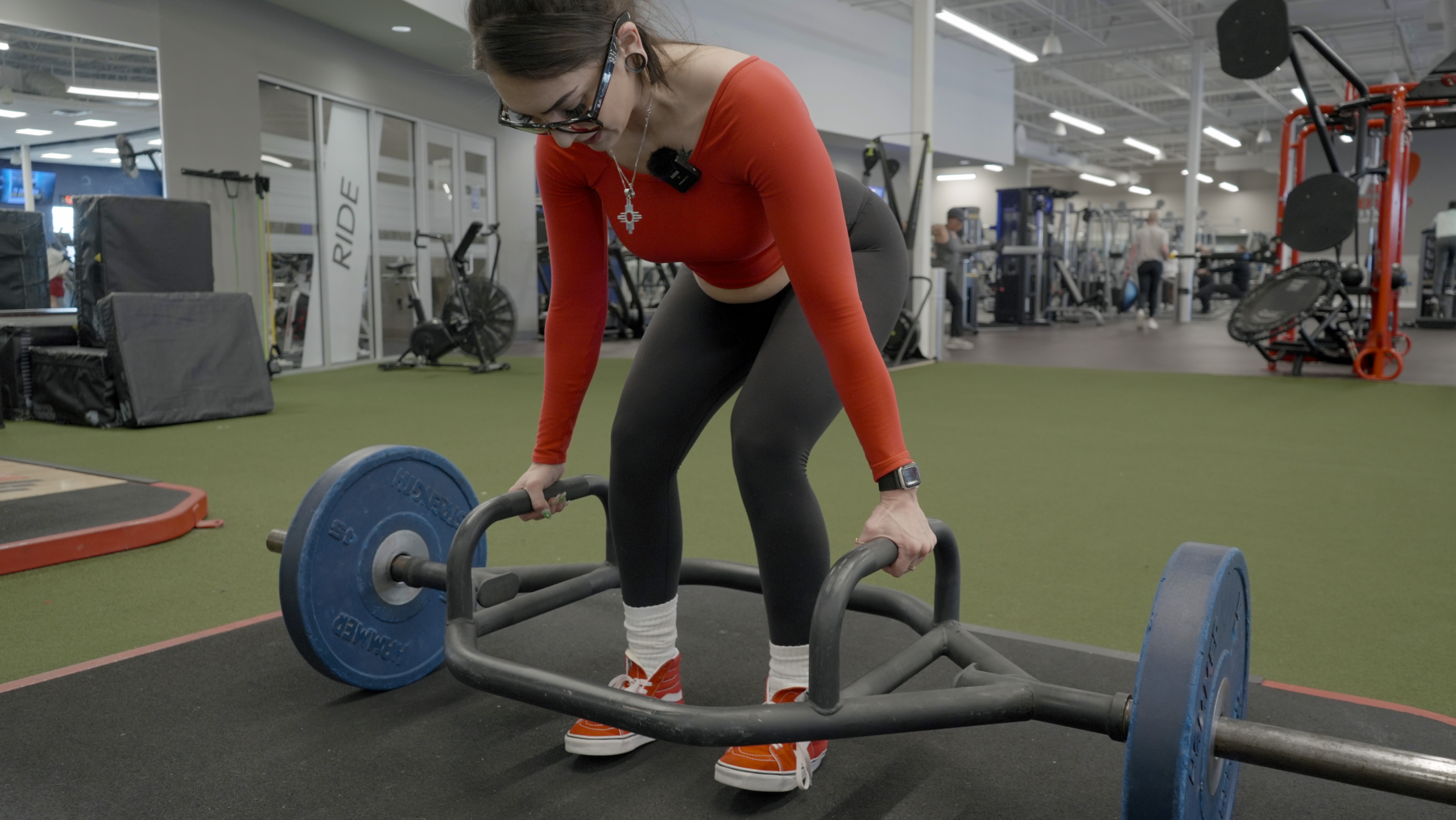
Push your hips back and bend your knees to lower your body towards the trap bar handles. Maintain a neutral spine and keep your back flat as you lower your torso. Grasp the center of each handle firmly, and rotate your arms so your inner elbows face forward to engage your back muscles.
3. Brace Your Core and Pull the Slack Out
Take a deep breath into your belly and brace your core, hips, and shoulders. Pull up gently on the handles until you feel tension in your arms and back, without lifting the plates off the floor yet. Your hips should sit higher than your knees, with your shins close to vertical and a light stretch in your hamstrings.
4. Push the Floor Away
Keeping a neutral spine, initiate the lift by driving your whole foot into the floor. Extend your knees and hips together so your chest and hips rise at the same rate. To maintain proper trap bar deadlift form, imagine that you’re tilting your pelvis like a bucket of water, keeping the water level balanced.
5. Stand Tall Without Leaning Back
At the top of the lift, stand tall with your shoulders directly over your hips and maintain your neutral spine position. Squeeze your glutes to finish the rep, but avoid leaning back or pushing your hips past your shoulders.
6. Lower the Bar Under Control
Begin the descent by pushing your hips back, maintaining a neutral spine throughout. Bend your knees as you control the bar’s movement toward the floor. Once the weight reaches the floor or your hands reach mid-shin, the repetition is complete. If you’re using a trap bar without weight plates, lower it until your hands are at shin height.
We’d recommend starting this workout without any plates on the trap bar, as the lack of extra weight will increase safety and allow you to focus on mastering proper form.
Should You Use High or Low Handles?
Use high handles if you’re a beginner or have limited mobility, since they shorten the range of motion. Switch to low handles once you can set up with a flat back.
The trap bar typically features two sets of handles: low handles for a deeper squat-like position and high handles for a more upright posture. If you have mobility issues or are a beginner, stick to using the high bar handles as they reduce your needed range of motion and make getting into the starting position easier.
Plan to progress past the high handles once your setup feels consistent. A simple test is whether you can grip the low handles with your hips above your knees and your back flat. If you can, the low handles train a fuller range of motion and build more strength from the floor.
Some lifters keep using high handles on purpose, either to work around a mobility limit or to lift heavier loads over a shorter distance. Both are reasonable choices, as long as you pick your handle height deliberately.
Common Trap Bar Deadlift Mistakes to Avoid
Small setup errors can shift the work away from the muscles you’re trying to train. Watch for these five common mistakes as you practice:
- Jerking the bar off the floor: Yanking the weight up before you’ve braced puts extra stress on your back and arms. Pull the slack out first and drive smoothly through your feet.
- Turning the lift into a squat: Dropping your hips too low takes your glutes and hamstrings out of the movement. Push your hips back first so the lift stays a hinge.
- Letting your hips rise first: When your hips shoot up before your chest, your lower back ends up doing most of the work. Keep your chest and hips rising together.
- Leaning back at lockout: Overextending at the top strains your lower back without making the lift more effective. Finish by standing tall with your glutes squeezed.
- Gripping off-center: Holding the handles too far forward or back causes the bar to tilt. Grip the middle of each handle so the load stays balanced.
How Many Sets and Reps Should You Do?
Aim for 2–3 sets, and train your legs at least twice a week. Beginners can use a light weight for 8–12 reps, while strength-focused lifters can go heavier for fewer reps.
The American College of Sports Medicine’s 2026 resistance training guidelines recommend training each major muscle group at least twice a week, using heavier loads for 2–3 sets when strength is your goal. For power, the guidelines suggest moderate loads lifted as quickly as possible, which plays to the trap bar’s speed advantage. ACSM’s earlier 2009 guidelines pointed new lifters toward 8–12 reps, a useful range while you learn the movement.
Pick a weight that lets you finish every rep with the same form you used on the first. Because the trap bar deadlift is a demanding full-body lift, it works well as the first exercise of a lower-body day or pull day routine, when you’re freshest.
How Much Does a Trap Bar Weigh?
Most trap bars weigh between 45 and 70 pounds, depending on the brand and design.
The reason for the varying weights is due to a lack of standardized trap bar dimensions, meaning a trap bar from one brand may weigh differently from another. As a result, it’s essential to check the trap bar’s weight before you work out with one to make sure you know how much you’re actually lifting.
Trap Bar Deadlift FAQs
Is a Trap Bar Deadlift a Squat or a Deadlift?
It’s a deadlift, since the weight starts on the floor and you lift it by extending your hips. The upright torso and deeper knee bend add some squat-like quad work.
Is the Trap Bar Deadlift Hard on Your Knees?
The trap bar places more load on your knees than a straight bar. Build up the weight gradually, and check with a doctor or physical therapist if you have knee pain.
Can Trap Bar Deadlifts Replace Regular Deadlifts?
For most people, yes. Unless you compete in powerlifting, the trap bar can be your main deadlift and still build full-body strength.
Build Lower-Body Strength With a Defined Fitness Personal Trainer
Learning a new lift is easier when someone can watch your setup and correct small mistakes before they turn into habits. Defined Fitness personal trainers work with members at every fitness level and can help you choose the right handle height, starting weight, and rep range for your goals. Between sessions, you’ll have room to practice on your own in the free weight areas at all 8 of our New Mexico clubs.
Explore our personal training programs to get matched with a coach. If you’re new to Defined Fitness, start with a free trial pass at the club nearest you.